Replication
Replication is the foundation of almost everything you expect from a serious database: high availability, read scaling, migration without downtime, geographic distribution and recovery in another region. It is also the mechanism that degrades most quietly — a replica stopped for weeks keeps answering queries, with stale data.
This page covers the mechanisms. The full per-engine topologies live in MySQL, PostgreSQL and ClickHouse.
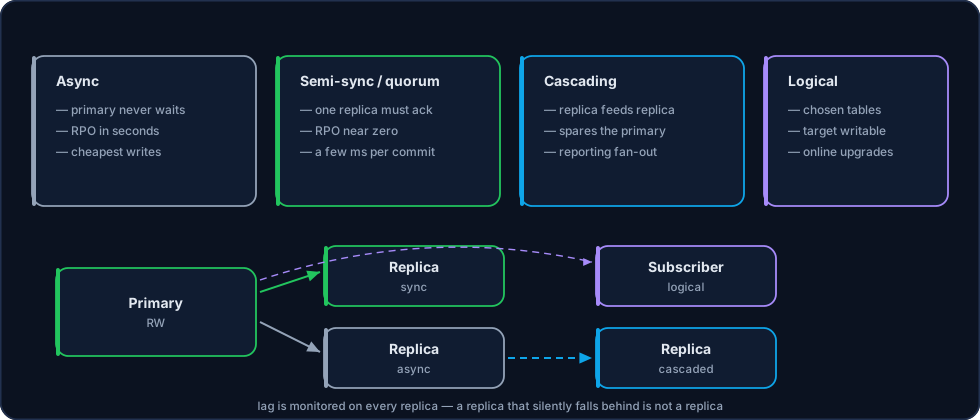
Choosing a topology is choosing an RPO and a cost per transaction — not a preference.
Physical or logical
| Physical replication | Logical replication | |
|---|---|---|
| What travels | Blocks / records from the transaction log | Changed rows, at operation level |
| Fidelity | A byte-for-byte copy of the primary | Selective: chosen tables and columns |
| Versions | Requires the same major version | Tolerates different versions |
| Target | Read-only | Can take writes of its own |
| Cost | Lower | Higher, per applied row |
| Typical use | High availability, failover standby | Migration, version upgrades, extraction for BI |
A production cluster usually uses both: physical for the failover replicas, logical to migrate, upgrade a version or feed an external consumer.
Commit modes
The mode defines the RPO — how much data it is acceptable to lose.
| Mode | COMMIT acknowledgement | RPO | Cost |
|---|---|---|---|
| Asynchronous | Immediate; the primary doesn't wait for the replica | Seconds of data at risk | Lowest write latency |
| Semi-synchronous / quorum | After at least one replica confirms receipt | Near zero | A few milliseconds per transaction |
| Strictly synchronous | After the replica applies it | Zero | Highest; the replica enters the critical path |
| Across regions | Same, with the replica in the other region | Near zero, survives the loss of a region | The metropolitan link latency |
The most common arrangement: one semi-synchronous replica to guarantee the data and one asynchronous replica for reads and reporting, so reporting never sits in the write critical path.
A replica is not a backup
Replication faithfully copies mistakes too. A DROP TABLE on the primary reaches the replica in milliseconds. Against human error and logical corruption, what protects you is backup with point-in-time recovery.
Topologies
- Primary with replicas — the standard. One write source, several read sources.
- Cascading — a replica feeds other replicas. Relieves the primary when there are many consumers, at the cost of adding lag at each hop.
- Across regions — a replica in br-sp-1 and br-sp-2, interconnected by Lan2Lan links or encrypted tunnels. See Multi-Region MySQL and Multi-Region PostgreSQL.
- Distributed multi-write — no single primary, with per-range consensus. That is the CockroachDB model, and it solves local writes in several regions — a problem classic replication does not solve.
Read routing
Having a replica does not scale reads on its own: the application has to use it. Routing belongs in the proxy layer, not scattered through the code:
- ProxySQL (MySQL) and PgBouncer with separate endpoints (PostgreSQL) expose
-rwand-ro. - Reporting and export queries always go to a replica.
- Reads that need data just written (read-your-writes) stay on the primary, or use a mechanism that waits for a replication position.
Lag: what to monitor
Lag is the health metric of replication, and it needs more than one angle:
| Metric | What it reveals |
|---|---|
| Delay in seconds | The business view: how old the replica's data is |
| Distance in bytes / log position | Whether the replica is progressively falling behind |
| State of the replication processes | A replica stopped on an error — the worst case, because the delay in seconds can even look stable |
| Retained log space on the primary | The primary keeps log for lagging replicas; a stuck replica can fill the primary's disk |
Frequent causes of lag: an oversized batch write on the primary, a replica with weaker hardware, single-threaded change application, a long transaction open on the replica, or saturated I/O.
A lag alert needs two thresholds
One for the delay the business accepts (say, 30 seconds) and one for lag growing over several minutes — because a replica drifting away slowly eventually reaches the point of needing a rebuild.
Rebuilding a replica
When a replica falls behind past the retained log, or shows divergence, it is rebuilt — not "repaired":
- remove the replica from read routing;
- recreate it from a physical backup or a recent snapshot;
- resume replication from the recorded position (GTID/LSN);
- wait for lag to reach zero;
- verify consistency with a sample checksum;
- return it to read routing.
On Kubernetes this cycle is driven by the operator; on virtual machines, by a script versioned in the runbook.
Failover in one sentence
A replica only counts as protection if promotion is reliable: detection by more than one observer, fencing of the old primary, promotion of the most advanced replica and redirection through the proxy. The details are in MySQL, PostgreSQL and in the disaster recovery plan.
Related Pages
- Backup & Restore — What replication does not protect
- Disaster Recovery — Cross-region replication inside the DR plan
- Performance Tuning — Scaling reads without overloading the primary
- Migration — Logical replication as a migration tool
- MySQL · PostgreSQL · ClickHouse · CockroachDB