Managed Multi-Region Kubernetes
A Kubernetes cluster does not have to be limited to one datacenter or one cloud provider. InteSys operates managed clusters whose worker nodes can sit in a single region, spread across our two Brazilian datacenters, or be distributed among different providers — always as one Kubernetes environment.
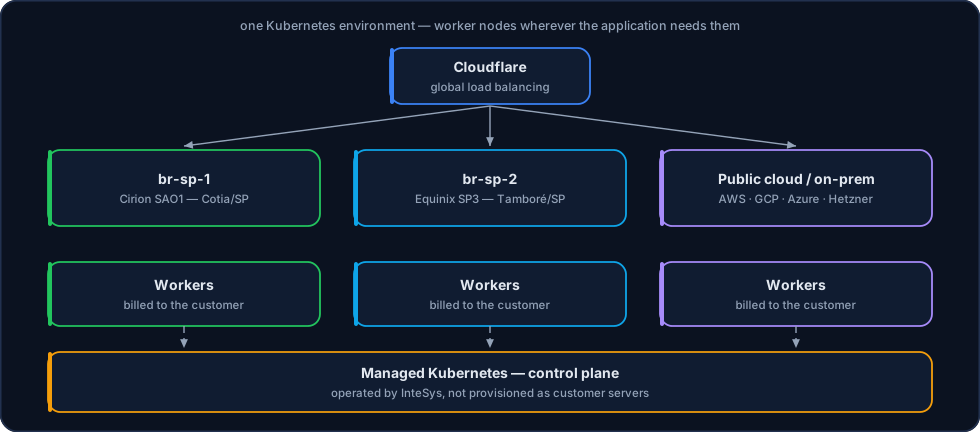
From the application's perspective, the nodes are part of the same cluster. From the infrastructure perspective, each group of nodes belongs to a different region, datacenter or provider.
Where worker nodes can live
| Location | Detail |
|---|---|
| br-sp-1 | Cirion SAO1 — Cotia/SP, Brazil |
| br-sp-2 | Equinix SP3 — Tamboré/SP, Brazil |
| Public cloud | AWS, Google Cloud, Microsoft Azure, DigitalOcean, OVHcloud, Hetzner |
| Customer infrastructure | Own datacenter or colocation |
| Other compatible environments | Evaluated case by case |
There is no requirement to use InteSys infrastructure exclusively. The combination follows the application's requirements.
The control plane is not on your bill
In traditional Kubernetes environments, the customer has to provision servers dedicated purely to the control plane — in a highly available setup, usually three machines that run none of the application's workloads.
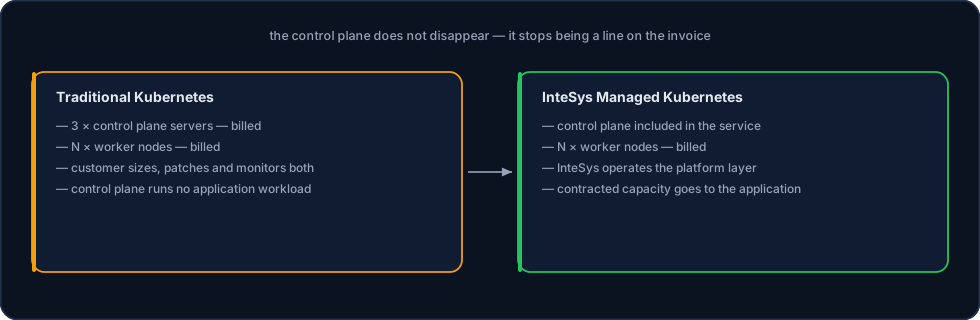
The control plane does not disappear from the architecture: it is abstracted, operated and provided by InteSys as part of the platform.
Customers pay for the computing resources used by their worker nodes. CPU, memory, storage and traffic vary with the selected region and provider — which also makes it possible to use each provider where it offers the greatest technical or commercial advantage.
Deployment models
| Model | Arrangement | Suited to |
|---|---|---|
| Single region | Workers in one region | Regional applications, simplicity and cost as priorities |
| Multi-DC in Brazil | br-sp-1 + br-sp-2 | High availability with all data inside the country |
| Hybrid | InteSys + public cloud | Extra capacity, DR or international reach |
| Multi-cloud | Two or more providers | Reduced dependency on a single provider |
What InteSys operates
- Platform lifecycle — stable, supported versions, upgrade planning, progressive worker upgrades and controlled node replacement.
- Cilium networking — identity-based L3/L4 policies, namespace segmentation, network observability and node-to-node encryption when the architecture calls for it.
- Layered security — operating system hardening aligned with CIS Benchmarks, least-privilege RBAC, Pod Security Standards and restrictions on privileged containers.
- Topology as policy — nodes labelled by region and zone, enabling automatic distribution, anti-affinity, topology spread constraints and PodDisruptionBudgets.
- Operating systems chosen per project — minimal, Cloud Native or immutable distributions, selected for compatibility, attack surface and compliance requirements.
Customers keep control of their workloads: namespaces, deployments, services and applications. InteSys operates the Kubernetes platform required to run them.
Managed, not merely hosted
The goal is not to hand over servers with Kubernetes installed. The platform itself is operated as a service — including upgrades, networking, security policies and cluster health monitoring.
Choosing the architecture
There is no single multi-region architecture that suits every application. A globally distributed stateless application has very different requirements from a transactional database that must keep all data in Brazil.
| Requirement | Typical architecture |
|---|---|
| Lower cost and simplicity | Single region |
| High availability in Brazil | br-sp-1 + br-sp-2 |
| Disaster recovery with another provider | InteSys + public cloud |
| Reduced provider dependency | Multi-cloud |
| Users across different continents | Global Kubernetes |
| Existing customer infrastructure | InteSys + on-premises |
| Data restricted to Brazil | Workers and storage in Brazilian regions |
Evolution is gradual: start in br-sp-1, add br-sp-2 for high availability and, when a real requirement appears, bring in public cloud or your own infrastructure. There is no need to start global in order to get there.
Next Steps
- Deployment Models — Single region, multi-DC, hybrid and multi-cloud
- Multi-Region & Multi-Cloud — Regions, zones, scheduling and global load balancing
- Stateful Workloads — Where data can — and cannot — move
- Platform Security — Hardening, Cilium and managed lifecycle
- Day-to-day Kubernetes — Deployments, probes, HPA and ingress
- Database Administration — Managed databases inside or outside the cluster
- Contact Us — Discuss your cluster architecture