Platform Security and Lifecycle
Security does not depend on a single component. It is applied in layers, so that the failure of one does not expose the whole application.
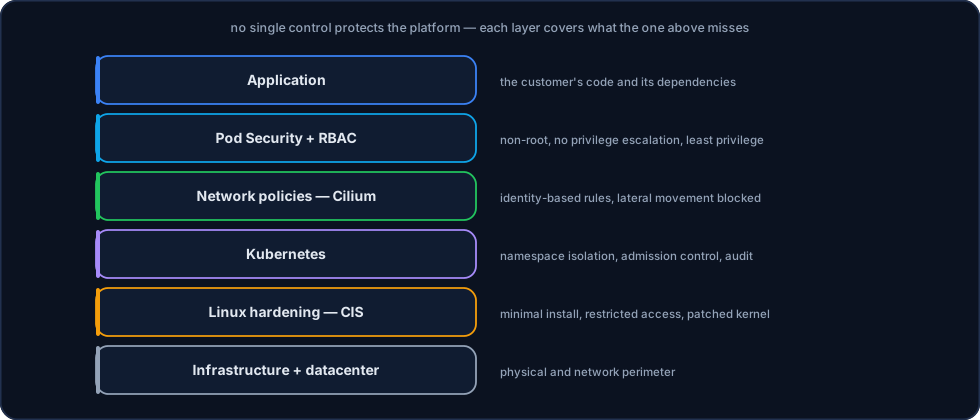
Each layer covers what the one above lets through — and the level of protection can be adapted per environment, without requiring every application to use exactly the same configuration.
Worker operating system
The solution does not depend on a single Linux distribution. Worker nodes use the operating system appropriate for the project's compatibility and security requirements: minimal distributions, Cloud Native distributions, immutable systems, enterprise distributions or hardened profiles.
The selection considers application compatibility, attack surface, lifecycle management and compliance requirements. The objective is to keep the worker OS as a controlled platform layer, without unnecessary services and components.
Hardening applied can include:
- minimal installation, with unnecessary services removed or disabled;
- controlled updates, in a maintenance window;
- restrictive filesystem permission policies;
- restricted or disabled SSH access depending on the profile;
- kernel hardening;
- configurations aligned with CIS Benchmarks when required or contracted.
Kubernetes layer
At the platform level we apply:
- least-privilege RBAC — service accounts with only what they need;
- Pod Security Standards — restrictions on privileged containers;
- namespace isolation — separation between teams, environments and applications;
- non-root execution, with reduced Linux capabilities;
- read-only root filesystem, where the application supports it;
- resource policies — requests, limits and per-namespace quotas;
- auditing and monitoring of the control plane.
Networking with Cilium
The cluster's networking layer uses Cilium, which allows connectivity and security to be applied directly to workloads, with identity-based policies instead of IP addresses:
| Capability | What it delivers |
|---|---|
| L3/L4 network policies | Explicit control over who talks to whom |
| Identity-based policies | Rules that survive pod IP changes |
| Namespace segmentation | Isolation between environments and teams |
| Network observability | Visibility of allowed and blocked flows |
| Node-to-node encryption | Encrypted node traffic, when included in the architecture |
In practice, the frontend talks to the API, the API talks to the database, and the frontend does not talk to the database. This reduces lateral movement if an application is compromised.
Policies are defined according to each cluster's isolation requirements — there is no single set imposed on every environment.
Managed lifecycle
Clusters run stable, supported Kubernetes versions. InteSys manages the platform lifecycle:
- upgrade planning and supported-version tracking;
- progressive worker node upgrades, with no environment downtime;
- component compatibility and CNI updates;
- workload validation after each update;
- controlled node replacement;
- cluster health monitoring.
The objective is to keep the platform current without transferring the operational complexity of that maintenance to the customer's team.
Division of responsibilities
| Layer | Owner |
|---|---|
| Datacenter, network and infrastructure | InteSys (or the provider chosen for that region) |
| Worker operating system and hardening | InteSys |
| Control plane, upgrades and CNI | InteSys |
| Network policies, RBAC and namespaces | InteSys, per customer requirements |
| Applications, images and dependencies | Customer |
| Schema, data and business rules | Customer |
InteSys does not replace your development team
The most common model is InteSys taking on the platform, networking, infrastructure security and lifecycle, while the customer's team stays owner of the applications running on top of it.
Related Pages
- Managed Kubernetes — Platform overview
- Multi-Region & Multi-Cloud — Topology, scheduling and global load balancing
- Day-to-day Kubernetes — Deployments, probes, HPA and ingress
- DevOps as a Service — DevSecOps, CI/CD and observability
- Contact Us — Discuss your environment's security requirements